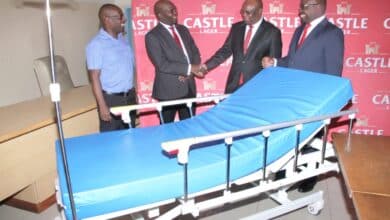




THE name of one of Zimbabwe’s pioneering black medical practitioners will live on for generations after Cimas Health Group renamed its Bulawayo Medical Centre the Sipho Zwana Medical Centre in honour of the late doctor’s remarkable contribution to medicine.
The renaming ceremony, held in Bulawayo yesterday, brought together the Zwana family, Government officials, medical practitioners, Cimas representatives and other guests to celebrate a man whose 52 year career helped shape Zimbabwe’s medical profession.
Cimas chief executive officer Vuli Ndlovu said the occasion was not about a company giving something to a family, but about a family entrusting Cimas with the name and legacy of a remarkable Zimbabwean.
“Today, a family gives something to a company. They are giving us a name, and once we accept it, we can never give it back. That is the weight of this occasion,” Ndlovu said.
Born on March 19, 1933, at Tekwane Mission, Dr Zwana was the second born son of Reverend Solomon Zwana and Maria Zwana.
His rise into medicine came at a time when opportunities for black Zimbabweans were severely restricted.
He was among eight African students listed in a 1954 government circular for medical training bursaries, a group that also included future national figures such as Dr Herbert Ushewokunze and Dr Samuel Parirenyatwa.
Ndlovu described the bursary list as more than a piece of government paperwork.
“That was not a bursary list. That was a country being written into existence, 26 years before it had a flag,” he said.
Dr Zwana went on to qualify as a medical doctor from the University of Natal Medical School in 1960, becoming the first Ndebele to qualify as a medical doctor.
A year later, he became the first black doctor permitted to work at Mpilo Central Hospital in Bulawayo.
His achievements did not end there.
In 1970, Dr Zwana became the first black Zimbabwean anaesthetist after obtaining a Fellowship of the Royal College of Surgeons.
His career took him across Zimbabwe and beyond, including the United Kingdom, Ghana and Kenya, where he worked and taught at institutions including Cardiff Royal Infirmary and Korle Bu in Accra.
He returned to Zimbabwe in 1981 and later worked at Bulawayo Central and Mater Dei Hospital, where he remained until his retirement in December 2013 after 52 years in medicine.
Dr Zwana died on February 16, 2019.
Ndlovu said the late doctor’s choice of anaesthesia was particularly significant because it was a speciality in which success often went unnoticed.
“The anaesthetist stands at the head of the bed, in the dark, holding a stranger’s life at the exact point between too much and too little,” he said.
“He was the man who watched while you slept.”
Ndlovu said that philosophy of quiet service resonated with Cimas, which has itself spent decades providing healthcare services often without public recognition when things go right.
“Our best days are our invisible days: the emergency quietly covered, the surgery that simply proceeded, the family not ruined by an illness they could never have predicted,” he said.
The Minister of State for Provincial Affairs and Devolution for Bulawayo Metropolitan Province, Judith Mkwanda Ncube, said the renaming was about preserving the memory of those who built Zimbabwe’s health system.
“Today, we are saying that the contribution of those who built Zimbabwe’s health system must not fade with time,” she said.
“We affirm that excellence deserves to be remembered. And, perhaps most importantly, we are saying that a good legacy should not simply be admired. It must challenge the next generation to do even better.”
Minister Ncube described Dr Zwana’s achievements as particularly significant given the barriers facing black Zimbabweans during his formative years.
“He did not merely enter the profession. He excelled. He served. That is the lesson we must carry forward,” she said.
The Minister also commended Cimas for choosing a permanent tribute rather than simply placing a plaque in honour of the medical pioneer.
“A plaque can commemorate a person. A building can keep their name alive, but the greatest tribute is the values that person stood for to continue influencing how we work,” she said.
The renaming also comes as Cimas marks its 80th year in healthcare, having evolved from a medical aid society established in 1945 into a broader healthcare and wellness organisation.
Ncube said the private healthcare sector had an important role to play alongside Government in expanding Zimbabwe’s healthcare capacity through investment in infrastructure, technology, diagnostics, medical professionals and wellness services.
For Cimas, however, the new name represents more than institutional branding.
Ndlovu said naming the facility after Dr Zwana was an attempt to make his story part of everyday life in Bulawayo.
“A naming is infrastructure for memory,” he said. “It is the deliberate act of placing a story where it cannot be quietly lost.”
From now on, patients walking through the doors, medical professionals reporting for duty and young people pursuing careers in healthcare will encounter the name of a man who broke barriers and devoted more than half a century to medicine.